01 / Ingest
Normalize robot telemetry, video, maps, events, and mission state.
Built for technical evaluators, robotics leaders, physical-AI partners, and enterprise automation teams. Technical credibility without the documentation.
Normalize robot telemetry, video, maps, events, and mission state.
Join live and historical context into one queryable operational record.
Apply access controls, approvals, and auditable operating workflows.
Power teleop, intervention routing, and fleet command surfaces.
Feed post-mission learning back into deployment and policy.
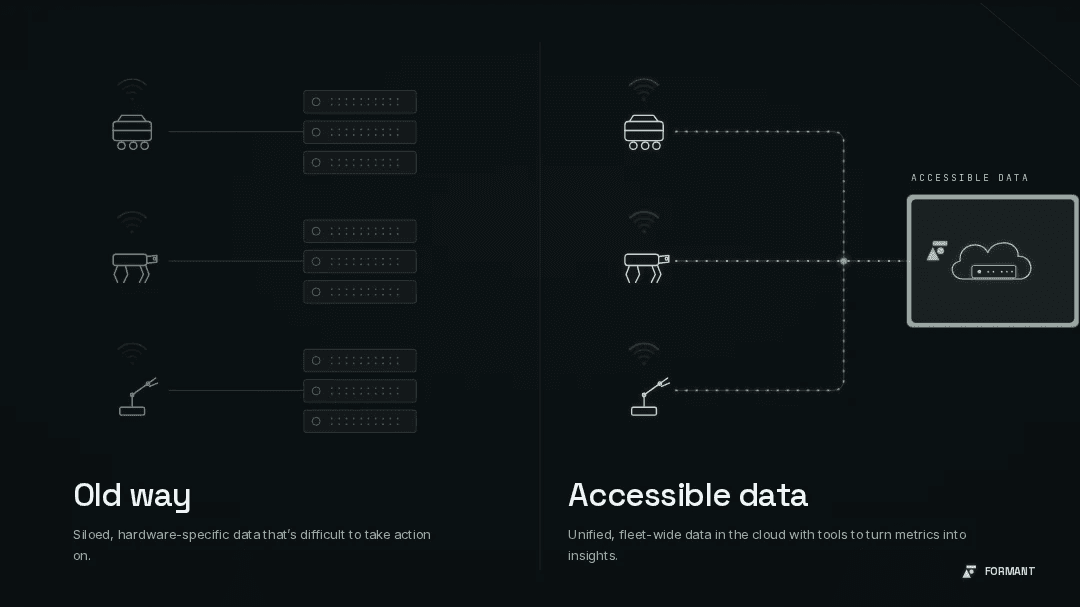
Enterprise-grade controls with fleet-wide visibility across environments, time, and machine types.
Enterprise-grade controls with fleet-wide visibility across environments, time, and machine types.
Enterprise-grade controls with fleet-wide visibility across environments, time, and machine types.
Enterprise-grade controls with fleet-wide visibility across environments, time, and machine types.
Route model outputs through policy-aware interfaces, with human-in-the-loop control and auditability before commands reach real machines.
Neutral and extensible architecture designed for mixed fleets, mixed tools, and long-lived production deployments.
Neutral and extensible architecture designed for mixed fleets, mixed tools, and long-lived production deployments.
Neutral and extensible architecture designed for mixed fleets, mixed tools, and long-lived production deployments.
Single environment, curated tasks, limited governance, and one-off integrations.
Multi-site operations, reliability targets, operator workflows, policy enforcement, and continuous improvement loops.
Built for technical evaluators, robotics leaders, physical-AI partners, and enterprise automation teams. Technical credibility without the documentation.
Continuous time-series capture, retained and queryable across the fleet.
Multi-sensor context tied to the moment and place it was captured.
Events, incidents, annotations, and logs unified into a reviewable record.
Bounded commands, workflows, SSH, and live teleoperation with operator control.
Normalized device metadata and operational context across every vendor.
Role-based permissions and audit trails enforced across every surface.
Route model outputs through policy-aware interfaces, with human-in-the-loop control and auditability before commands reach real machines.
No direct model-to-actuator path. Every action is bounded, attributable, and reviewable.
Implementation is tailored to fleet topology, customer systems, and operating model — with governed execution from day one.
Connect robot-specific interfaces into one operational layer.
Integrate ticketing, alerting, identity, and operational workflows.
Ingest and normalize local sensor, event, and facility context.
Forward-deployed support to land outcomes and scale deployment safely.
Bring your robot types, vendors, deployment model, workflows, and integration questions.
Talk to Formant →Built for technical evaluators, robotics leaders, physical-AI partners, and enterprise automation teams. Technical credibility without the documentation.
Normalize robot telemetry, video, maps, events, and mission state.
Join live and historical context into one queryable operational record.
Apply access controls, approvals, and auditable operating workflows.
Power teleop, intervention routing, and fleet command surfaces.
Feed post-mission learning back into deployment and policy.
Enterprise-grade controls with fleet-wide visibility across environments, time, and machine types.
Enterprise-grade controls with fleet-wide visibility across environments, time, and machine types.
Enterprise-grade controls with fleet-wide visibility across environments, time, and machine types.
Enterprise-grade controls with fleet-wide visibility across environments, time, and machine types.
Route model outputs through policy-aware interfaces, with human-in-the-loop control and auditability before commands reach real machines.
Neutral and extensible architecture designed for mixed fleets, mixed tools, and long-lived production deployments.
Neutral and extensible architecture designed for mixed fleets, mixed tools, and long-lived production deployments.
Neutral and extensible architecture designed for mixed fleets, mixed tools, and long-lived production deployments.
Single environment, curated tasks, limited governance, and one-off integrations.
Multi-site operations, reliability targets, operator workflows, policy enforcement, and continuous improvement loops.
Built for technical evaluators, robotics leaders, physical-AI partners, and enterprise automation teams. Technical credibility without the documentation.

Continuous time-series capture, retained and queryable across the fleet.
Multi-sensor context tied to the moment and place it was captured.
Events, incidents, annotations, and logs unified into a reviewable record.
Bounded commands, workflows, SSH, and live teleoperation with operator control.
Normalized device metadata and operational context across every vendor.
Role-based permissions and audit trails enforced across every surface.
Route model outputs through policy-aware interfaces, with human-in-the-loop control and auditability before commands reach real machines.
No direct model-to-actuator path. Every action is bounded, attributable, and reviewable.
Implementation is tailored to fleet topology, customer systems, and operating model — with governed execution from day one.
Connect robot-specific interfaces into one operational layer.
Integrate ticketing, alerting, identity, and operational workflows.
Ingest and normalize local sensor, event, and facility context.
Forward-deployed support to land outcomes and scale deployment safely.
Bring your robot types, vendors, deployment model, workflows, and integration questions.
Talk to Formant →Built for technical evaluators, robotics leaders, physical-AI partners, and enterprise automation teams. Technical credibility without the documentation.